Showing posts with label DMC Medici. Show all posts

Thursday, 14 May 2020

How many sleeps 'till Christmas?

In this case, -2334.

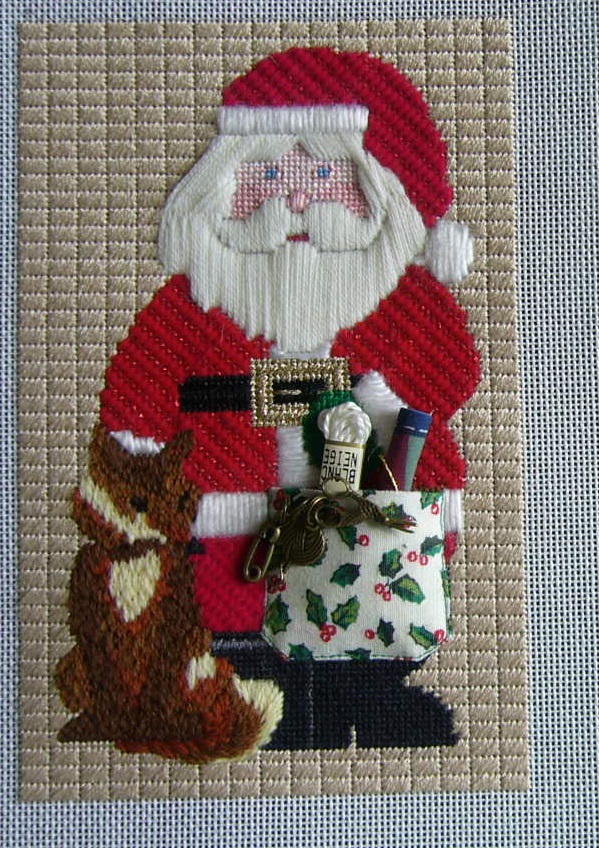
I stitched "Santa" and "Mrs Santa" in 2013 for the American Needlepoint Guild Auction of that year. All funds from the auction go to the Education Fund. This funds projects to make the public more aware of Needlepoint, to encourage them to try it, and to raise its profile as an art.

These were painted canvases, without a stitch guide, so although I had to pretty much follow the general colours indicated, I was able to choose my own stitches.


I have to admit now that I enjoyed stitching these little fellows so much that I forgot to record just about everything about them. I do recall that I mostly used DMC Medici, and the background is Soie d'Alger. I made their bags from some Christmas material I had on hand, and filled them with small sewing items. Each had a pair of scissors, some threads, not all of them visible in my pictures, and a roll of 'something to stitch on'.

Sometimes it's fun not to think about time and just let your needle run with your imagination.

Thursday, 22 November 2018

Tea Anyone?

Inspiration can come from all sorts of places. In 1987 I was given a present of a small book of examples of Japanese woodcuts in the Ukio-e (Pictures of the Floating World) style. One of the woodcuts was by Utagawa Toyoharu (1733-1844) and was titled "Interior and Winter Landscape: A gay party, men and Geishas".


Despite my lack of experience I decided that I would like to render the image in needlepoint.

I began this project in March 1988, starting from the 6 inch by 4 inch, postcard sized picture in the book. Not quite as clueless as heretofore, I realised that the figures were very detailed and that to do them any justice they must be stitched on a high count canvas, with a finer thread. The rest of the picture did not feel, to me, as though it needed the same level of detail. Somewhere along the line I made the first design decision. I would work the figures on 22 count and the rest on 11 count. Not being particularly aware of other flosses or yarns, I stuck with Appletons Crewel and DMC Medici.

Back then, with no computers, limited access to photocopiers and no digital nothing, it all had to be done by hand. I have alluded to my lack of ability to draw, but if you seek hard enough you can find a solution. My solution was the pantograph. Using one, I traced the outlines of the figures onto graph paper expanding them to the size required, and filled in the detail by eye. Each figure was charted and stitched separately apart from the two overlapping figures on the right which were completed as one piece. All the figures were worked in tent stitch on 22 count canvas using 2 strands of DMC Medici and appliqued to the background.


The background was drawn out on graph paper by hand and eye. It was stitched on 11 count using 3 strands of Appletons. The background is mostly tent stitch, but with a flash of bravery (or boredom?) I essayed into different stitches for the Tatami matting and the bamboo porch behind the figures. The completed project, not including the mount and frame, measures 27 inches by 13 inches. The standing Geisha is about 11 inches in height.

Was there a lesson to be learned?

First, let's start with frames. Scroll frames are a pain. At no time can you see the whole canvas, and every time you move the canvas you have to re-lace it, and keeping it suitably taut and even is not as easy as it looks. I found that the further on I got with the project the more I was struggling to stop the canvas going out of shape. I partly solved the problem by padding the unstitched areas, but only partly! It was some time later that I discovered the joy of stretcher bars and thumb tacks.

Secondly, there's size. Size matters! I failed to leave sufficient extra space beyond the area to be stitched. At times I was working so close to the side bars that I had difficulty in controlling the needle and ending threads. (Of course that might just have been me.) Now I always leave at least a two inch space between the edges of my design and the edge of the canvas on all sides. (That extra couple of inches also means that you can do quick doodles in the corners if you don't have a doodle cloth handy.) That extra two inches can mean the difference between satisfaction and frustration.

I also learned how fiddly it is to try and join two pieces of canvas invisibly, though I did cheat by planning (or more likely by luck?) to have the join run vertically behind the standing figure. I also discovered that in general, picture framers have little experience of framing needlepoint.

I started "Tea Dance - Nippon Style" in March 1988 and did not complete it until June 1989. I learned so many things about designing and stitching during this project, and though today I can look at it and see many things I would do differently now, it still hangs in our sitting room and I am still proud of it. One day perhaps I will revisit it. I still have the original design sheets somewhere!


Wednesday, 17 October 2018

Passionate Pineapple

Done!
Well the pineapple's complete! What I have not said about it so far is that it is stitched on 28 count Antique White linen using Ecru DMC perle 8 and 12. The finished pineapple is 5½ inches high, 3 inches wide.
Having got this far, I'm going to put on a Nun's Stitch (Or is it Nuns' Stitch) edging.


And another lesson!
When I took it off the hoop there was a double crease in the linen that took an age of careful pressing on both sides to remove. Next time I'm working on a ring I'll loosen it off when I'm finished stitching for the day.

Thursday, 27 September 2018

And then I made a carpet

The cushions had gone well and I was gaining confidence, so why not?


Okay, it was a doll's house carpet.
It measures about 5" by 6" and is based on the carpet in Hans Holbein's portrait of George Gyscze (painted 1532).
It's worked in 2 strands of DMC Medici on 22 count mono canvas using a design by Susan MacBaine from her Dover book "Needlepoint Rugs for Dolls Houses" ISBN 0-486-23388-x.

It was a request from my mother. She had a large dolls house, unfurnished and could I make her some carpets?
Did I dare to say no?
How difficult could it be?


It wasn't that easy after all!
Nothing to do with the instructions, more the lack of ability of the stitcher.

This was where I first learned that not all threads act in the same way, that you have to treat each one with the respect it requires. I also learned that I needed to take more care over my tension and the stress on the canvas.

It looked fine, but I knew it wasn't good when I took it off the frame and it immediately went from an oblong to a trapezoid. Luckily, I'd already read up about blocking needlework and with a bit of judicious pinning down I managed to (almost) get it back into its proper shape.

Mother still liked it, but like the Danes, she asked for more.