Tuesday, 16 August 2022

Tucson

 Eight months!! I blame the three L's. Lassitude, Life and Laziness.

I've been busy, but I couldn't share until after the ANG Seminar in Tucson. We got back last Monday and slept for two days, but now we're catching up.

To bring you up to date with "The Big Project" I kept mentioning, it was for the Exhibit at the ANG Seminar, so I didn't want it to be seen until then. It was both a risk and an adventure I will probably write more about later, but here is the finished article.

It's called "Heraldic Carousel" and measures just over 12 inches high. Each side is 4" across and the baseboard is 12"x12".


It does what it says in the title, it's based on heraldry, and it's a carousel. 
The sides along the bottom are the heraldic ordinaries set in shields. The ordinaries are gold or silver (Or and Argent), with the couching on the shields in the heraldic tinctures of red (Gules), green (Vert), blue (Azure) and Purple (Purpre). The background to each panel is Milanese stitch, also in the heraldic tinctures, with a Basketweave border in brown.
The creatures are the heraldic beasts, Unicorn, Leopard, Griffin, Hippocampus, Lion, Dragon, Sea Lion and Wyvern. They are all double sided. The 'beasts' are worked in Kreinik braids and the background in Soie d'Alger, in Basketweave.
Above them, the red and blue swags, are Beattie stitch turned on its side to emulate hanging fabric. The tent like top is natural calico.
All the embroidery was worked on Congress Cloth. 
The frame is balsa wood, because it had to be light enough to carry, and inside is a musical movement which plays Brahms Lullaby when the handle at the top is turned.

I have to say that when I submitted this as an Exhibit entry I had no expectation of winning anything - possibly an Honourable Mention because it is a bit unusual. The main reason for creating Heraldic Carousel was to make people look at it and think "S**t! You can do that with Needlepoint? Wow!" It certainly got that reaction.

Surprisingly (to me), when it appeared in the Exhibit it did so with a Blue Ribbon - First in Professional Original! Later in Seminar it was also awarded "Creative Inspiration" and, I had to stuff my napkin in my mouth to stop me screaming when the next one was announced, "Best of Show".


Ribbons are so cool. Creative Inspiration is a beaded Gila Monster, Best of Show is a perfect little hummingbird.

And did it work?


It took me nearly 900 hours to make Heraldic Carousel. There was much failure, much pain and much heart rending, and I doubt if I'll ever do something like that again.


Thursday, 25 November 2021

Return of The Pod People

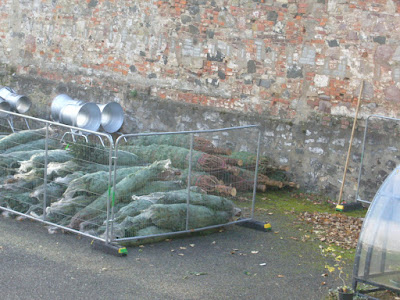
 As we come to the end of November, what we call "The Pod People" return. Looking out of my back window I can see this:


Every year at this time there is a gathering of Christmas Trees for distribution in the yard next door. Wrapped as they are, they always remind me of the 1956 film "Invasion of the Body Snatchers.
I think if you look at the still from the movie it's kind of self explanatory.


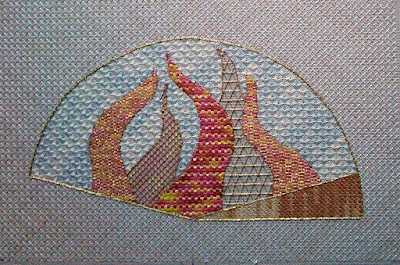
Back in May I mentioned that I had been selected to teach my "Flame Fan" at the American Needlepoint Guild Seminar 2022, in Tucson, Arizona. I didn't feel quite right about sharing "Flame Fan" until the classes were advertised, but as they are now up on the ANG website, I think its OK to do so.


I was supposed to be running a pilot class this week, but due to various circumstances I have had to postpone it until the end of February.  (If you live near Edinburgh, places are still available.) I knew there was a lot of work in running a class, but I don't think I understood how much. Still, we live and learn.
Having done the grunt work, I'm looking forward, with a little trepidation, to the pilot, and then to the class itself, which will be in August.
Flame Fan is 7" x11", and is worked on Congress cloth. The flames are all worked in couched Kreinik gold, using the same variegated Anchor floss. Stitching time was about 30 hours.

I have been busy on other things too. "The Big Project" has come to a temporary halt because I haven't had the git-up-and-go to move on to the next stage. Mr.G's tablecloth proceeds in small increments,


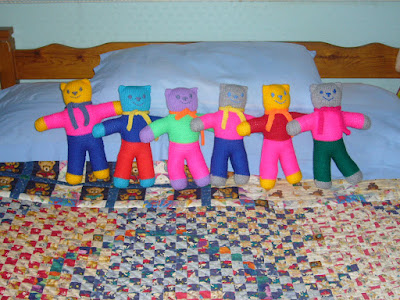
and another group of bears is off to a new home.

Not so many this time, which is good as I had so many other things going on, but the request for half-a-dozen was filled. They're obviously keen to get on their way, the fellow in the green trousers is already stretching his leg out towards the door.

Friday, 17 September 2021

I lost August

Last week was July and suddenly we're in the middle of September. I'm sure that someone out there is speeding up time.

Not that I have nothing to show for it. My attempts to learn Hardanger continue with limited success on the technical side. I can Kloster and Eyelet and Buttonhole, but I'm still having problems with my woven bands. The finished diamond is a mess, but I hope to do better with the next one. At least this time I didn't cut the wrong threads and have to re-weave them.


The poor thing is getting a bit creased with being carried around, so I'll need to sort that out, but The Mysterious Mr. G seems pleased with it so far.


I've been taking this to my Monday group, Leith Friendly Crafters. Crochet is the in thing at the moment, but I'm working on them. One of these days someone is going to join the embroidery corner of the table.

I also got volunteered by a friend. She runs a craft group at CafĂ© Sentosa, in Albert Street on a Wednesday evening (5.30 to 8.30).  "Would you come along and bring whatever you're working on? You just have to sit there and give advice, or show people how". It seems to be going well, though there are things we take for normal (as learned in the USA) that are new to people here. When I brought out a frame weight they were impressed, when I stripped and laid threads on 'The Big Project' they were fascinated.

'The Big Project' is still taking up a lot of my stitching time, but I'm now onto the inner base. Only four more of these to do and the main part of the stitching is complete. Next comes the frame. That's going to be fun. I know where I want to get to, but I'm still not 100 percent sure how to do so.


I know I'm going to need advice and probably assistance for the next bit. I may start with a visit to our local Model Railway shop. How do you link Needlepoint and Model Railways? I haven't an answer on that yet, but when this project is finished I intend to create a dedicated page with the whole story.

And somewhere in that lost time I baked our Christmas cakes. Plural. Every year I make one for us and one to share with friends. They get baked on the last weekend in August or the first in September and then every two weeks they get taken from their boxes and given 'a wee dram'. According to the recipients, it's best not to drive after a slice.

Friday, 23 July 2021

Maybe Next Month

Is it me or are the months passing more quickly? Jane-Beth says it's my age. I'm not so sure, but then that might just be my age. 

It only seems about a week since I wrote about my leap into the world of Hardanger, but it's been a month. It's been an exciting month in its way. With lockdown easing I have been able to visit my Chiropractor and my Dentist. That's exciting? Maybe not quite the right word. Pleasing doesn't fit either, but I was 'well pleased' to discover that after nearly a year and a half of lockdown and shielding I didn't need any dental work. With the Chiropractor, it's back to the old monthly 'adjustments', which I feel the better for. 

The relaxation also means that I can get together with the other "Leith Friendly Crafters".

Photo Courtesy of "Inspiring Leith"

This is me alfresco stitching in the summer sun with some of the other members of the group. Yes, there are two men. I'm still working on finding men who do embroidery and persuading them out of their corners. And yes, that is me at the front left, working on a test piece for my current "big project".

What about the Hardanger? How is that going?
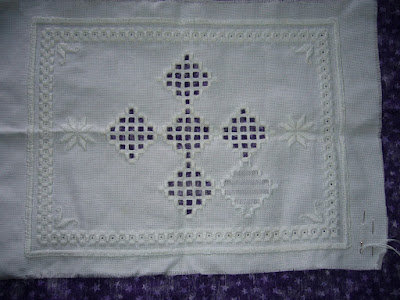
The Mysterious Mr. G decided I should start his tablecloth. Three rows of Klosters as a border and five diamonds of them in the middle, he instructed. I obliged.


I'm working in the traditional white on white using Hardanger linen and DMC Perle 5 and 8. The Klosters are all worked in the Perle 5. It took me 20 hours to get this far. 
Next, Mr.G pronounced that he wanted a Blanket Stitch outer border, and could he have eyelets in the central row of the outside Klosters? And a long-ship motif in each corner?


Why not? After another 7 hours, the Blanket Stitch border is complete and the first corner of eyelets and long-ship are in place. I am using the Perle 8 for the eyelets.
I don't think I fully realised how thread hungry Hardanger is. It took two skeins of the Perle 5 to complete the Klosters and the Blanket Stitch. When the excess linen is cut back to the Blanket Stitch, Mr. G's tablecloth will measure 9" by 12". 
Considering it's my first piece, I don't think it's too bad, though there are some fairly rough bits. 

The Mysterious Mr. G. inspecting the work so far.

I'm not sure what we're planning to do next, but I did hear him muttering about cutting threads and woven bars.

Still, it's nice to have something I can put in my pocket and work in-hand.

Tuesday, 15 June 2021

Headbanger

 Last time, I mentioned that I had been trying Hardanger. I started from the basics, using Janice Love's "Hardanger Basics and Beyond" and of course the support and advice of Jane-Beth who said that I should start with Kloster Blocks.
I tried to find an ISBN for the book, but I think it's self published. The back cover credit is to a shop called Love'nStitches in Athens, (Georgia, not Greece). One thing I loved about this book is that at the end of each section Janice gives instructions for left handed stitchers.

I always think of Hardanger as being white on white, but I decided that since I had no idea what I was doing I'd work with a coloured perle. I started with a vibrant orange on green. That was a disaster - vision wise - so I gave up and tried orange on white. Why orange? It just happened to be at hand, as did the teal and the red.

My first 'doodle-cloth'

Kloster Blocks are simple. (Left side of image.) Well the basic stitch is simple, but then you have to remember how to move to the next block without leaving a trailing thread on the back. Trailing threads are a no-no. It's not that Hardanger is 'double sided', but as it's used for table cloths and such like, the stitches should be well enough finished that it should be difficult to tell front from back. I'm not going to embarrass myself by showing you the back of my doodle-cloths.

My second 'doodle-cloth'

After Klosters, Buttonhole. I'd not tried that before. It didn't go well to start with, but it's one of those stitches you can get into a rhythm with - until you come to a corner. I got lost on them to begin with, but perseverance was rewarded.

My Third 'doodle-cloth'

After about 30 hours I have reached the stage of the image above and tried eyelets, which I had done before, wrapped bars (bottom right) and woven bars (top right) both new to me. I also managed to cut the wrong threads.
It still needs lots of practice, but 'The Mysterious Mr. G' of whom I have written before has decided that I am almost competent enough to make him a table-cloth. He may have to wait a little longer.

Speaking of whom, in earlier blogs I've mentioned his army of knitted bears, using which he plans world domination by teddy-bear. I recently received a picture of some of his minions starting their work.


Tuesday, 18 May 2021

May? Already?

One and a bit years after our first lockdown things are starting to look more positive. I have had both vaccinations and Jane-Beth gets her second today. Lockdown is easing, little by little. The pubs are starting to open and I am getting back into the garden. Not my Dad's, the house has been sold, but I have a couple of friends who need what muscle I can provide, so with a bit of decent weather I will soon start to get rid of my lockdown flab. 
And the dentist has reopened! What can I say? I dislike going, but I know it's necessary, and I haven't been able to go since March (last year).

I seem to have let this blog slip since the arrival of Covid. It's not that I've been doing nothing, but the time has been sucked up by other projects.
I have recently become a columnist for Needlepointers, the magazine of the American Needlepoint Guild. I was sort of volunteered for it, and it's been an interesting experience. The feedback has been positive too, which is a bit of a boost for the ego.
In an earlier entry I mentioned that my "Flame Fan" design has been selected as a class for the American Needlepoint Guild Seminar in 2022. I can see at least one column for Needlepointers and a future blog entry or two coming out of that!

"Would I mind if the other designs were offered to the Distance Learning Team?" I was asked. Of course I didn't mind. The ANG Workshop By Mail team asked if they could have "Golden Gyron". Ab-so-lootley! So it will be appearing in Needlepointers in a few months and will probably run from February to April 2022.


"Golden Gyron" is 5" x 5" and is worked entirely in gold, with the 50th anniversary of ANG in mind, but also as a sampler of stitches aimed at the less experienced needlepointer. I'm hoping it will go down well.

Work continues on 'The Big Project' which I hope to have finished for Seminar 2022. This is my first trial of how I might finish the beasts. The idea is to have them hanging, with the animal on each side, but with a different colour of background. I need to work on it a bit more! Luckily I have a couple of beasts that I'm not going to use, so I have material to practice on.


I've also been trying Hardanger, but my efforts so far are so execrable that I'd be embarrassed to put in a picture. Maybe next time.

On the down-side, no in person American Needlepoint Guild Seminar again this year. I'm not sure yet whether I will sign up for any of the on-line classes. However, I remain hopeful that next year at Tucson will go ahead (and that we'll be able to travel from Scotland).

Friday, 26 March 2021

Things you find in odd corners.

I was searching for something else when I came across this piece. It wasn't exactly that I had forgotten it, but once its purpose had been filled, I put the box in a corner.

A year and a half ago we made one of our regular visits to The Georgian House to attend a talk on 18th Century dress. One of the young ladies giving the talk was working on a piece of embroidery, so of course I had to go and speak to her. (No names, it wouldn't be fair to embarrass anyone.)

She had never tried surface embroidery and it wasn't going well. Someone had told her to use one length of thread without explaining that there were six strands. I don't think I need say more than that. She had also managed to get a massive and unentangleable (not sure that's a real word) knot. My heart went out to her. I explained that she should only be using one or at most two strands of the six, and that she was using far too long a length of thread. It was more fingertip to underarm than fingertip to elbow. She was keen to learn how to do it properly, so I said I'd come back the following week with a partly stitched piece.

As usual, I got carried away and by the time I returned I'd stitched most of this:


It's a flower spray based on a design I found in "18th Century Embroidery Techniques" by Gail Marsh, ISBN 978-1-86108-476-7. It's a pretty cool book, with lots of diagrams and pictures. The petals are worked in a single strand of Soie d-Alger using silk shading.

Let me say here that I hate doing silk shading on canvas, but I do like a bit of surface shading on other fabrics. 

We talked about transferring designs. She had heard of pricking and pouncing, but not how to do it. My advice was 'Don't'. I suggested that she trace the main outlines of her chosen design on thin tissue paper and baste it through. In my opinion it's better than prick and pounce and much better than drawing the design on the fabric, and the tissue comes away easily if you use short stitches.
We talked about weight of thread, the above is all worked with one strand, the joys of French Knots, and stitch direction for silk shading. I also advised outlining areas such as the petals in a stem stitch to give a smooth curve and a firm edge.
Of course I also showed her how to do some of the stitches.

AND I hoped I hadn't bored the young lady to death.

The finished piece measures about 6" across and lives in an i-pad box.


Wednesday, 10 February 2021

Am I A Happy Bunny?

Ecstatic, might be a better word, but also nervous, a little frightened and feeling well pleased with myself. 
Why?

I submitted three proposals for classes to be taught at the American Needlepoint Guild Seminar in Tucson, 2022, and one of them, "Flame Fan" has been selected. I am going to be teaching at Seminar! 
Cool, but worrying! It's a tick on my bucket list, something I've wanted to do for years just so I can say I've done it, and I'm looking forward to it with just that sense of trepidation.

Next steps? It's well over a year away, but I still need to tidy up the stitch guide and find some local embroiderers to pilot the class. I also have to gather the class materials and find out what I need to do about visas that allow me to work in the USA. And there will be all those things I haven't thought about yet!

Will I get the teaching bug?
I don't know. I may be a terrible teacher, or it may all go swimmingly. Only time will tell.

Since I don't know the rules, I'm assuming I shouldn't share the selected design with you. All I'm saying at this point is that it's worked with variegated threads and a gold metallic. Well, you know me, I like a bit of bling.

On bling, since I can't share "Flame Fan", I thought I'd share a bit of bling with you.

These are part of my current BIG project. Planning ahead, it probably will not be finished until 2022.


As you can see, I've looked at heraldry again. The silver and gold are from my collection of Kreinik metal threads, the colours, or tinctures, are Soie d'Alger. Then there's this bit.


The cute dragon is all worked in Kreinik metallic threads. It's worked on congress cloth, using #8 braid, which is maybe a little on the thick side, but I wanted to give the figure bulk as well as bling. The dragon is worked in Tent Stitch, to get the detail, and is about 3" tall. I wasn't going for even-ness of stitch here, but for the sparkle as the figure moves.
I can almost hear you thinking "what's the nutty Scotsman at now?
The background is, not surprisingly, Soie d'Alger in Basketweave. 

This project has gone through starts and stops and disasters. The metal threads were no problem. We have a large collection of Kreinik metals gathered over the years. The BIG DISASTER was the backgrounds to the figures (there are a number of them). Having carefully calculated how much thread I needed, I discovered I had miscalculated. I tried to get more of the same, but the dye-lots had changed and I just knew I'd not get a match. 
Solution? I may have to re-work all the backgrounds I've completed. I doubt if I have sufficient of some of the metals to totally re-stitch all of the figures, so I'll just have to rip out the backgrounds that don't match.
Frog-stitching - what fun (not). I'm not looking forward to it, but it will be an improvement when it's done.

Wednesday, 13 January 2021

What's in a Name?

Last night, Jane-Beth mentioned that it was over a month since I had last updated my blog. A month? When I looked, it was over two months. Where does time go? I mean it's not that I've been doing nothing, but these are, as the politicians and commentators tell us, Unprecedented Times, and we're probably all a bit out of kilter.

It's been nearly a year since the Pandemic hit the UK. and it's been a year unlike any other that I can remember. That's despite many of my 'friends' claiming that I'm so old I remember The Black Death ("Not enough people left to bury the dead.") of 1384.
You may well have guessed that since I am writing this, we have not been smitten by Covid. That's mostly down to Jane-Beth, who has kept me inside most of the time. I have been Locked Down, Shielded, Protected, and now I'm back in Lock Down again. Despite the arrival of vaccines I fully expect to remain in Lock Down until at least May. It's not that I'm a pessimist, but it takes time to inoculate over Sixty Million people.

We had a bit of a relaxation of the restrictions over the summer, which did allow me to go and visit my Dad and get his garden tidy. Gardens, aren't they incredible? Before the pandemic I spent five years bringing some semblance of order back to a garden that hadn't been as much as weeded or pruned for at least ten and maybe nearer fifteen years. Between April and July I couldn't visit him because he lived on the opposite side of the River Forth. When I got back in August it was like the garden had grown two years in three months!
I was glad I was able to get back to visiting him. I'm not sure he actually knew who I was by then other than 'a young relative who comes to do the garden'. Old age and dementia had taken its toll on Dad, and at 93 years old, and never having recovered from a stroke he had some years ago, Dad took another stroke in October and didn't recover. Pandemic restrictions meant that only immediate family and grandchildren were able to attend his funeral, but we gave him a proper send-off. Dad had spent years in the military, starting during WWII, then later as a Naval Chaplain, so he had the flag-draped coffin with the officer's cap and his medals on top of it. No hymns allowed, everyone masked, and only the Minister allowed to speak, but he went off to the music of Eternal Father (the Naval Hymn) and Sunset. Yes, I got a bit choked. I miss him, but it's for the best. He knew he was, as he said himself, 'aould an' ravelled' and 'abun fit til gang'.
Apologies, but I felt that I had to share that, if only for my own benefit.

"So what have you been doing?" You might well ask. I've been working on a few pieces that might become classes, and as ANG members might have spotted, am about to appear in the next issue of 'Needlepointers'. The Editorial team asked if I would submit a project and I offered them this:


Watch out too for "Thoughts From A Far Country.

And moving rapidly on, A QUIZ.
What is the name of this stitch?


I call it Dinnaken Stitch. Why? Well when I was stitching this:

I was asked what the stitch was. Now that one stumped me for a moment. I couldn't remember where I had found it or what it was called, so I said "dinna ken" (translation, "I don't know").
Afterwards, I went through more stitch books than I care to think about - our embroidery library's a bit like an Aladdin's cave - and I couldn't find it in any of them, so it became "Dinnaken" Stitch.

And with couching:

So this is the quiz.
Can you name that stitch?

Wednesday, 11 November 2020

Or nue flower

I don't often go on classes in the UK, but in 2017 I did take the opportunity of a class on Or Nue, at the  Scottish National Portrait Gallery. The class was taught by Helen McCook, a Royal School of Needlework graduate.

The design is based on a detail from the painted wall decorations on the pillars of the upper gallery. If you have the opportunity, the Scottish National Portrait Gallery is worth a visit just for the architecture and decoration. Of course, it's also full of portraits!


For some obscure reason I did not record the notes and timings I usually keep on pieces. No idea why. The gold is Japanese Gold #2, the flosses are DMC stranded cotton using one strand, stitched on blue satin. The design is only about 5 inches across. Helen taught us various types of fillings and explained how they could be used to emphasis shape and depth.
It was a fun class, with lots of interaction and lots of discussion about influences, from Arts & Crafts, back through Restoration and Jacobean to the Eastern influences brought in by the arrival of Indian and Japanese fabrics and embroidery.

This was never meant to be one of those pieces I would hang on the wall, but once finished it needed protected. I didn't want to place it under glass or just put away in a drawer and forgotten about, and I did want it to be portable but safe. I found the perfect storage for it, an I-Phone box.

Thursday, 8 October 2020

Kaitlyn

Who or what is a Kaitlyn?

It's 2017, and she's a who. Kaitlyn is the grand-daughter of the lovely woman who cleans my Dad's house. So how did I get involved in making something for her? It's a bit of a convoluted story.
'Gran', as I'll call her, is only supposed to do the heavy cleaning, but we all know that she spends longer with Dad and does more for him than she gets paid for. Elder Brother, otherwise referred to as The Major Domo was trying to find some indirect reward that she might accept as a recognition of this. Had we any ideas? Well I did.

Occasionally, when across to visit him in my capacity as Head Gardener (for those who remember The Herbs, they call me Bayleaf) 'Gran' would be there and we would chat about all sorts of things. She was fascinated that I embroidered and knew stuff about Japanese things as Kaitlyn was 'into' Japanese things and was decorating her room in a Japanese sort of style, loved Kimono and so on. It was coming up to a Birthday (or maybe it was Christmas) and 'Gran' was trying to find something in a Japanese style for Kaitlyn who wanted 'a Japanese Scroll' to decorate her wall. I suggested to The Major Domo that I could stitch a scroll using Japanese embroidery techniques, which 'Gran' could give Kaitlyn as a unique gift.
Offer made, offer accepted.

First, of course, I had to come up with a design. I decided that a simple scroll with her name in a Japanese script would be just the thing. I looked up her name on a few translation sites and found Kaitlyn in Kanji and Katakana. It looked very 'heavy' in Kanji, but the Katakana had a lighter feel to it, more suited for a young girl (she was just approaching her teens). 
Translated, Kaitlyn means 'purity' so my design had to have a clean and unencumbered look. I looked at name 'chops', which led me to the idea of a simple border in red with the Katakana in black, edged with couched silver, on a white background.
I drew out my design and offered it to TMD.

"Go for it," he said
I did. I decided that the best fabric to use would be Shioze as it is quite heavy, but easy to stitch on (the prominent weave helps with maintaining the angles of the stitches). Then I had to frame up. As I had intended from the start, this was to be stitched in the manner of Traditional Japanese Embroidery, so the cotton end pieces had to be stitched to the silk Shioze and then wound drum tight and stretched on the frame. Once the silk was mounted, I made a stencil of the design on tracing paper and attached it using magnets while I copied a running stitch outline of the design.


If you've never seen one before, the frame may look a little different to what you're used to. The point is to keep the silk as tight as possible during the stitching process, so the rollers at the end are split to give added grip and the fabric is stitched along the sides to ensure that it is well stretched. Incidentally, Traditional Japanese Embroidery is worked from the side.
Having transferred the pattern, 


I was ready to start stitching.
Following the rules, I began with the Katakana. These were stitched in black flat silk which was either worked as flat silk or twisted by hand by me where I wanted to use a twisted silk. Each symbol was worked in a different stitch.


Then the border was added. The tissue paper is there to protect the embroidery. It always ends up a bit tatty and torn as I only uncover that part of the piece I am working on in that stitching session.


Then the silver was couched round each of the Katakana, and gold on the inside and outside of the border.


And still it wasn't finished. 

When the stitching is done, the frame gets turned over for the first time. The manner of starting and ending threads in Traditional Japanese Embroidery means that there is no weaving through the back, and no big knots. Once it's on its back it needs to be starched, steamed and dried. This has to be done very carefully as the starch should only go on the back of the embroidery, otherwise it might stain the fabric.

The finishing touch, once it was off the frame, was to turn it into a scroll by attaching it to some heavy (furnishing) fabric and a hanger.


It took me 60 hours to design and stitch Kaitlyn, which measures approximately 14" x 24". I enjoyed working on it as much as I enjoyed the look of pleasure on "Gran's" face when I gave it to her.

Also, 'Gran' comes up trumps by providing an absolutely unique present.

Friday, 25 September 2020

Dynamic Sisters and Handbags

 Still in New Orleans, I took three classes. 

The first was "Dynamics of Teaching", led by Val McAleenan. Unsurprisingly it was about teaching Needlepoint. I'm not sure that I will ever teach embroidery in a formal way, but I thought it would be interesting to hear a teacher talk about the inter-relationships that happen in an embroidery class. As someone who has in the past trained people in basic IT skills and IT Security (and who tries to be a good boy in class), I was aware of the different types of students found in the business environment, and was, in a way not surprised to find that all of the same types attend embroidery classes. The big difference is that in a business environment the attendee has generally been sent, while in a Needlepoint class, the attendee has chosen to be there and has paid good $$$ for the privilege, so the way you treat the difficult or disruptive has to be, if not different, perhaps a bit more patient. 
I've done a little ad-hoc teaching since then, and I always let my student or students work at their own pace. You can't do this is a class of more than four or five, so you, as the teacher, have to be prepared to sit after class with the slower stitcher to make sure they know what they're doing and how to do it. I don't think there can be anything worse for a student than to be sitting without an idea of what to do. 
At one point it brought back to my memory my first French lesson. As usual, having returned from holiday in Singapore, I ended up in the school hospital for a week. Long story, put briefly, I had an allergy to the school issue vests which made me come out in spots, which the school assumed was some evil foreign disease I had picked up in the mysterious East, so I was hauled off to the school hospital for two weeks. Having been released, one of my first classes was French, of which I had absolutely no knowledge. The teacher (an ex-Polish cavalryman of WWII vintage) immediately rounded on this new face and asked me a question - in French. I had no idea. I shrugged, said I didn't understand, he got angry, he shouted at me. It took me some moments to understand that he was actually speaking English - yes, his English accent was like something out of a bad comedy movie. I became, in his eyes, the class failure, and from then on I dreaded French.
Lesson? Take care how you speak to students. A few badly chosen words can destroy confidence in seconds.
I hated French from that moment, but I'd like to put it on record that I had great respect for 'The Wee Pole' as he was nicknamed, as a man. You may have heard the story of Polish Cavalry charging German tanks in 1939. He was one of those cavalrymen. You can't not respect that.

Well, that was a long story for a one day class. My second class was with Janet Zickler Casey, and was called "Let The Good Times Roll!" (Or "Laissez Les Bon Temps Rouler!" - which I still pronounce in a Polish-French accent.)


As you can see, it's a handbag. The Fleur-de-lis is beaded, as is the handle. The class included teaching us how to make the beaded handle as well as how to stitch the body of the handbag. What drew me to this class was the teacher, whom I had already met a number of times. Jane-Beth had taken a few classes with her and raved about how good she was and how much fun her classes were.
On the first day of class, yes, me in my kilt as usual, the lady next to me asked, in a friendly manner, why a man would take a class to make a beaded handbag. I couldn't resist it, "a boy just can't have enough handbags," I replied. That broke the ice as the rest of the class realised I was just as nuts about Needlepoint as they were.
It was indeed a fun class, with lots of discussion around colour choices and personalising the design. There was lots of laughter, lots of stitching, and lots of discussion about colour, stitches and much else. You'll meet the handbag again.

The third class I attended in New Orleans was "Sisters" by Nancy Cucci. Obviously NOLA was my 'beading' year.


I chose this class for a number of reasons. I loved the design, particularly the repetition of the same stitches, but not in the same order, in the large squares. To me it made the point that in a family the siblings may all have started with the same genetic material, but we all become distinct individuals. I liked the colour selection too, the dark balancing the light, the overlaps of the squares slipping into companionship rather than opposition and the background pulling them all together like the members of a single household.
I had been wary of beads for a long time, but I wanted to take a class with Nancy. She was a great teacher, very relaxed and and yet attentive to every student. Thanks to her I am no longer afraid of small shiny things. It was great fun and I really enjoyed every minute I spent working on "Sisters". I still haven't decided which Brother, I have three, deserves this.
Sisters measures 5½ x 10½ inches and is worked on 18 count canvas. It took me 75 hours to stitch.
If you like the look of "Sisters", you can find another version in Melita's blog, Melitastitches4fun. There's a link at the top of the page.

Monday, 14 September 2020

Things We Do On Our Holidays

We attend the ANG Seminar as often as we can manage. Apart from the classes and the shoppertunities, we like that it moves around, which means that we get to see a different place each year. The days at Seminar are filled with classes, events and meetings, so we always try and arrive a few days early to do touristy stuff.

We walked where we could, and we found the Streetcars. That was fun, even if we did get on the wrong one and end up at the terminus. Still, we saw dozens of fine looking houses and beautiful gardens. Walking, I had the chance to admire the wrought-iron work on the balconies of houses. I particularly liked this one.


We also found our way (a fairly short walk from our hotel) to the World War II museum. It is big, it is impressive, and it is educational. It's not all 'Blood and Glory', with sections on The Home Front, war industry and a massive archive, as well as many items of the machinery of war. There were tanks, Jeeps, aeroplanes and trucks, and right in the main entrance, a Higgins Boat. And next to the main entrance was a really good Forties themed cafe.
I had heard of Andrew Higgins. Eisenhower is said to have referred to him as 'the man who won the war'. Higgins designed and built the thousands of landing craft required for the Pacific campaign and the Allied landings in North Africa and Europe.
Obviously the people of New Orleans think highly of him as one of their 'Sons' because the street that leads to the Museum is called:


We also visited the Confederate Museum. It was much smaller, perhaps more personal because of that, but equally interesting. Such places may be frowned upon by many, but I think it's important that they exist in some form or other to remind us that history has two (or more) sides, and that to forget it is to repeat it.

Then there's the food. We went with a group of needle pointers to a well known, I might say famous, restaurant that has been there since forever. The food was incredible, a total melt in the mouth experience, and they had good Scotch Whisky. I think I did cause a bit of a stir. The MD, a very nice chap, seemed to find this man-in-the-kilt quite attractive (maybe he just wanted to find out if the rumours about what Scotsmen wear under their kilts are true). Then there was the young lady with her partner who kept looking, and whose expression indicated that she wasn't sure, ours being a group of ladies of a certain age, whether I was a man in a skirt or a hirsute woman (I have a moustache.)
And there was a traditional Jazz band playing in the street outside. As the saying goes, I thought I'd died and gone to heaven.

But what about the classes? Of course I took classes and I'll write about them next time.

Saturday, 5 September 2020

Man The Builder

 In 2015 we visited Myrtle Beach, in 2016 we ventured further into The South. The American Needlepoint Guild Seminar 2016 was to be held in New Orleans. How could we not go? New Orleans! The name alone conjures up a vision of the exotic, yet at the same time, pictures of the aftermath of Katrina. So off we went, Jane-Beth and me, and a bottle of Auchentoshan, and of course my exhibition piece. 

My entry for the 2016 Exhibit was "Man The Builder", a design I had started on in July 2015. If you were at Myrtle Beach, you might have seen a mad-man sitting on the floor in the shop with a big design sheet, picking out threads. Yep, that was me. 


Original work must be submitted to the Exhibit accompanied by an Artist's Statement. That read:

The inspiration for "Man The Builder" came from a variety of sources; pre-Reformation stained glass, the warm gold of the stone of the Scottish Border Abbeys, our need for places of contemplation and ritual whatever our beliefs and 'Cathedral Window' quilting (which I could never get the hang of). "Man The Builder" shows the growth of places of ritual from the first standing stones, through the Henge, to the great cathedrals and monasteries of the Middle Ages.
We know from Archaeology that men built temporary shelters close to their sacred places at times of festival and, later, small permanent houses, probably for their Shaman, priests or rite leaders. 
As beliefs and needs changed, these buildings replaced the Henge and were slowly enlarged, or new buildings erected, growing in size and importance, the culmination being the great cathedrals.
My object was to show this process as it might have been illustrated in an old stained glass window, with pictures of the evolving edifices engraved into small panes of glass.
I chose to use silk and metals to emulate the warmth of the sandstone and the glow and reflections of light through the glass and onto the stone. I chose to stitch the mullions in Soie d'Alger as I felt it gave the warm effect I wanted. The central part of each mullion was padded to show the curve of the stone and I used wave stitch on the outer border to reflect the long chisel marks left on the stone by the builder as he shaped it with his rudimentary hand tools.
Old glass is uneven in both texture and colour so I chose to show this using a substantial layer of Neon Rays couched with silver or gold to emulate the speckles often seen in early church glass. I tried various methods of adding the "etched" buildings, none of which I found satisfactory until I found a collection of coloured lighting gels in my mother's stash. I found that I could obtain the desired effect of etching over glass by drawing the building on the gel, cutting out the outline and attaching it to the "glass".

Later, I was offered a different take on what I had stitched:
When we were simple folk, our God (I use this as shorthand for any form of deity or belief system) was with us and all around us. When we became settled, our God stayed with us and the holy person made his abode close to the place we considered most sacred to our God. Then the priests took over and built bigger and bigger houses and locked our God in them.
It was a lesson to me that people might see something in my work which I did not intentionally put there. It doesn't worry me. If someone finds something of meaning to them yet which I didn't deliberately put there, they are welcome to take it away with them. If nothing else, it shows that they took the time to consider what they were looking at.

"Man The Builder" was stitched on 18 count white mono canvas, using Soie d'Alger silk floss for the mullions and borders. The padded areas were stitched with three layers of padding cotton before the silk was laid over the top. The central motifs or 'glazed areas' are in Neon Rays. The highlights on the mullions and the 'lead' round the 'glass' are couched Japanese #8 gold and silver while the bosses at the points of the mullions are a Heavy Passing Gold we inherited from somewhere. The buildings were drawn onto yellow stage lighting gel using an indelible black pen and attached using small stitches of black thread.
The stitched area is 12" on each side and it took me 190 hours to design and stitch. I had a successful Exhibit. "Man The Builder" was awarded Third Place in Class, a Judges Choice Ribbon, and the "Creative Inspiration" Award.

I don't usually include lots of pictures of a piece, but it has been suggested to me that people like to see the progress of a piece of work. I don't take many pictures as I go, but here are a few I took when working on "Man The Builder".


My Doodle Cloth. The test of the padding is in the top right. If I was doing this again I would consider making the padding stitches longer and maybe deeper.


Padded Mullions (white) completed mullions in golden brown Soie d'Alger.


The full piece with padding.


The finished piece.


The ribbons.

Thursday, 20 August 2020

Myrtle Beach and The Tree of Life

 I had to look it up in our atlas. I knew where South Carolina was, but I'll admit that until the American Needlepoint Guild said Seminar 2015 would be in Myrtle Beach, I'd never heard of it. Having got there, it reminded me very much of the west coast of Scotland. Of course, there's only the Atlantic between them. The main similarity was that it was wet. 
I think it rained pretty much every day we were there. There is a big difference though! The rain was warm! We got as far as the beach one day. "Did  you go for a swim?" asked one of our acquaintances. "Swim? If I'd known how warm the Atlantic could be I'd have brought a bar of soap and had a bath."
That was also the day we went hunting for a 'Starbucks'. It wasn't that we wanted coffee, but I have friends who collect Starbucks mugs and I always try and take them one from my travels. We also visited a surf-shop. What an explosion of colour! In the UK surfers wear wet suits, not colourful Lycra outfits.

We did other touristy things, including a visit to Hopeswee Plantation where I saw Spanish Moss for the first time. (I took this picture from Trip Advisor as it was much better than any of my attempts.)
It was an interesting tour, filled with detail about the history and the inhabitants, and about rice growing in The Carolinas.


I impressed by knowing who Mary Chestnut and Verena Davis were. I've even read parts of Mary Chestnut's diaries.

But we were there for the embroidery. I showed Endless Golden Knot and Polar Bear's Claw. I was awarded the Silk and Metal Ribbon for the former and an Honorable Mention for the latter, so a successful Exhibit for me. It pleased my teacher too. Endless Golden Knot was designed and taught by Michele Roberts (see my 10th July blog), and she was also the designer and teacher of Tree of Life.

I chose to do Tree of Life because I wanted to do a memory piece for my father, who suffered a stroke early in 2015 and was showing signs of dementia.


Tree of Life is worked on Congress Cloth and uses Kreinik Gold, beads, crystals and gold bullion metals. It measures 16" by 18" and it took me 75 hours to stitch.
The original had various religious symbols on the red circles (the fruits of the tree), but as this was meant to hang by my father's chair where he could touch it, I redesigned these to motifs that would mean something to him and might help him retain his memories.
Working clockwise from the bottom left, the symbols I chose are:
A trowel. My Dad always had an interest in Archaeology.
Burning Bush. He was brought up in the Church of Scotland, whose 'logo' is the burning bush from Exodus and whose motto is Nec Tamen Comsumebatur.
Five Pointed Star. Because he and Mum loved their annual visits to the USA.
Square and Compass. The symbol of Freemasonry.
Fouled Anchor. My dad spent many years in the Royal Navy.
A Cross. Dad was a Church of Scotland minister.
5 and Male. To remind him of his five sons. (When we lived in Singapore the local Chinese ladies were impressed - 5 children, all boys.
MP, Their initials intertwined, Peter and Margaret,
Boys Brigade Emblem. He was involved with that organisation for many years.
Davy Lamp. That was to remind him of his childhood in a small Fife mining village.

My Dad is 93 now, and has limited (and not very accurate) memory, but he is still in his own home and Tree of Life hangs next to his chair, close enough that he can touch it.
The constant touching may be bad for the embroidery, but if it helps him, I'm happy with that, and if I wanted I could always stitch another version.

Maybe I should start one for myself?

Friday, 7 August 2020

(Polar) Bears Claw

Those who have been following my blog will know that I occasionally make quilts. This isn't one.

Someone recently asked me where I got my inspiration from. The best answer I could give was "Anything and everything. I never know when it will hit and what will trigger an idea until it comes to me." That's the way it works for me. As Thomas Edison said of Genius, as the light bulb went on above his head, it's 1% inspiration, 99% perspiration. 
I find that when the inspiration comes, the initial idea can be sketched out as a first draft in a few minutes. After that comes the blood, sweat and tears. I know where I am, and I know what I want to achieve, but once I get the image it can take hours to draw a final version which I think meets my idea.
Then I have a drawing. Keep going, there are still the threads and stitches to select. Usually I have already decided on colours, but then there's the colour balance to be considered. Once I have the drawing, the colours balanced in my mind, and the stitches applied to areas, I can then translate the drawing into a chart. What about size? Mostly, I find, I don't have to think too much about that as the design will tend to indicate what size the finished piece should be.

What about the Polar Bear?
I did promise one in the title, so here is my Polar Bear:


The inspiration came from a previous quilt, "6 Bears +1", which had a Bear's Claw pattern round the border. "You could do something with that in Needlepoint," I thought. 
The initial sketch was a single Bear's Claw, like the quilt. The next version extended it to four paws reducing in size, with a partial border, as though it was the corner of a quilt.
For this piece, the title came next. (Polar) Bear's Claw. Why Polar Bear? Who knows, I just decided Polar Bear, maybe because Polar Bears, like male embroiderers, are an endangered species.
It was the title which decided the colours I would use. Obviously, Polar Bears are white(ish) so there was a predominance of off-white, The live on ice floes and the floes are surrounded by the sea, so the sea had to be a dark blue, the ice a pale blue.
Jings! What next? The Stitches. The paws, being the obvious large areas, needed to be white and suggest a certain furriness so I used a woven stitch to give them bulk. When it came to charting them I decided that the size of the woven stitch should remain the same for each 'paw print' and only the area of the 'paw print' should reduce. I also decided that the claws should be couched Kreinik silver. Why? It just felt right. 
As this was based on a quilt pattern I looked for a stitch that had a woven-fabric quality to it for the background. If you don't know this one, it's called Darmstadt Stitch and it's dead easy. It also covers the area at quite a rate once you get in the swing of it.
Having in my mind already decided that the sea would be the border, or was it that the border would be the sea, I sought something smaller and tighter than the Darmstadt and went for a Scotch Stitch with a zig-zag in the same off white as the paws. I deliberately left the ends 'hanging' to imply that this was a corner of a quilt.
It took some time to balance the stitch sizes to the drawing and chart the final design, but by taking the time to count it all out on graph paper, it does mean that the chart is a close reflection of the finished article. I say close, because there is almost always that point where a stitch, as charted, really just doesn't look right and you have to wing it. All you've got to do next is stitch it.

I have to admit that this is one of the few pieces I have designed where I haven't made some fairly major alterations to the stitch plan just because what looks good on paper doesn't work on canvas.

(Polar) Bear's Claw is 5" square and was mounted in a 12" square cold steel frame with a pale grey mount. I used Soie d'Ager silks and a Kreinik metallic silver throughout. It took me 50 hours to design and stitch. (Polar) Bear's Claw was exhibited at the American Needlepoint Guild Seminar 2015.

The last thing I stitched was a two row border that matched the mounting board. I like to add a tent stitch 'framer's friend' to all my needlepoint. My framer says that it gives a smoother transition between the embroidery and the canvas and makes for a better looking mount, I do it because if the mount is just slightly off, the framers friend can disguise it.

And breathe.